Blog
Sep 16, 2026

Our first pregnancy, which began naturally, sadly ended in a termination at 14 weeks after a serious structural chromosomal abnormality was detected in the fetus. Subsequent genetic investigations revealed that one of us carried an inherited structural chromosomal rearrangement, which had caused the severe chromosomal abnormality in the fetus. The news came as a complete shock, and at first it felt like a devastating setback after everything we had already been through.
During genetic counselling, we first learned about preimplantation genetic testing as part of fertility treatment. We were told that it could be used to identify inherited structural chromosomal rearrangements in embryos.
This knowledge immediately brought us an enormous sense of comfort – perhaps next time we could reduce the risk and avoid reliving the painful and dark experiences of our first pregnancy. We learned that, in Finland’s public healthcare system, fertility treatments involving preimplantation genetic testing were still relatively uncommon and were available only at HUS. Based on our diagnosis, we were eligible to join the treatment waiting list immediately. However, after the difficult events we had experienced, we took a little over six months to consider whether we were ready to begin treatment.
Preimplantation Genetic Testing (PGT) is a genetic (DNA) analysis performed on a small sample taken from an embryo. Based on the results, it is possible to select an embryo with the highest likelihood of leading to a successful pregnancy and the birth of a healthy child. PGT can be used to identify known inherited genetic conditions as well as chromosomal abnormalities.
Our hope of another pregnancy had not disappeared. The waiting time for PGT treatment at HUS was estimated to be around two years, which felt overwhelmingly long at the time. At the same time, trying to conceive naturally again felt too emotionally difficult and frightening, as the risks associated with the structural chromosomal rearrangement in our genetic makeup would always remain.
We began to find out more about preimplantation genetic testing and other clinics offering it. That was when we found Ovumia, a clinic about which we had heard only positive experiences. After six months of considering treatment, we contacted Ovumia and booked our initial consultation.
From our very first contact, Ovumia’s approach felt warm, empathetic and respectful. As it was clear from the outset that our treatment would involve PGT, after the first consultation with our doctor we also spoke with an embryologist by phone. The embryologist explained the different laboratory stages of PGT clearly, professionally and in detail. This complemented our conversation with the doctor and the information we had already received about the treatment.
After a thorough fertility assessment by Johanna, the doctor caring for us at Ovumia, we agreed that starting treatment soon would give us the best possible chance of success. Once we had received all the information we needed, we wanted to begin without delay. Ovumia was able to start our treatment as soon as we felt ready.
A few months after beginning treatment, eggs were retrieved and fertilised, and our embryos began to develop. The morning after egg retrieval, we woke to a text message from an Ovumia embryologist telling us that all the fertilised eggs had begun dividing in the laboratory as hoped. We still have that message, and the moment we received the happy news remains vivid in our memories.
Our embryos still needed to develop for five to six days before the biopsy sample required for PGT could be taken. Throughout that week, the Ovumia team kept us carefully informed about how our embryos were doing and how their development was progressing. Fortunately, the embryos developed as hoped and the biopsies were successfully taken. We then waited anxiously for several weeks for the PGT results.
In early November, around three weeks after egg retrieval, an Ovumia embryologist called to share the PGT results. Some of our embryos had the correct amount of chromosomal material and were suitable for transfer. Hearing the news filled us with a happiness that is difficult to put into words. Although the treatment was not yet complete, this already felt like a major milestone.
The results also meant that we could move forward. Together with our doctor, we began planning the treatment and timing needed for the embryo transfer.
The treatment and scheduling required before embryo transfer were planned at a pace that felt right for us. We knew that our embryos were safely stored while waiting for transfer, so there was no need to rush. In the end, we chose a frozen embryo transfer in a hormonally prepared cycle. A few months after egg retrieval, our doctor Johanna performed the embryo transfer. That same morning, Ovumia had called to tell us that our embryo had thawed successfully and everything was ready for the transfer.
When transfer day arrived, we felt happy but also very nervous, and we could only hope that the procedure would go well. Once we arrived at Ovumia, however, the warm, friendly and professional atmosphere helped ease our nerves. It was especially reassuring to know that the procedure would be performed by the doctor who had cared for us from the very beginning.
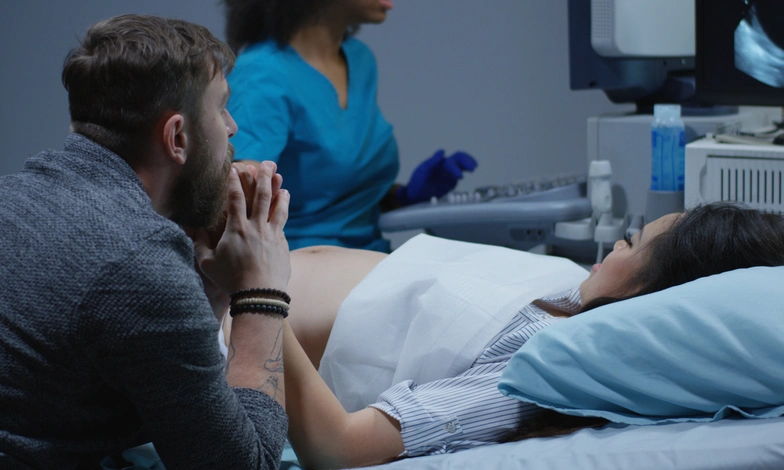
During the procedure, we were able to watch on the doctor’s screen as the embryo was transferred into the uterus. We will always remember how the embryo appeared as a tiny point of light on the screen. Afterwards, our doctor gave us instructions for the days and weeks ahead. Even more importantly, the doctor’s optimistic approach made the experience feel positive and helped us truly believe that the treatment could succeed.
Every day before it was time to take the pregnancy test felt long. We tried to keep ourselves busy and find other things to think about, yet our thoughts kept returning to the same question. During those almost two weeks, we went through many different emotions until the day finally arrived when we were due to take the test.
Taking the pregnancy test felt both frightening and incredibly nerve-racking. At first, we could hardly believe our eyes – two strong lines appeared on the test. We will never forget that morning or that day.
Pregnancy brought back painful and frightening memories from just over a year earlier. We were especially nervous about the first routine ultrasound examinations, where nuchal translucency and the fetus’s overall development would be assessed. We moved forward one day and one week at a time, reminding ourselves that all we could do was follow the guidance we received from Ovumia and trust the expertise of the professionals caring for us.
During the pregnancy, we chose to have additional ultrasound examinations at Ovumia. At each stage, they gave us renewed hope and confidence that the pregnancy was progressing normally. The examinations also provided reassuring information about the fetus’s wellbeing and development. We warmly recommend Ovumia’s expertise in pregnancy ultrasound examinations as well.
Almost exactly two years after the termination of our first pregnancy, our long wait finally came to an end when we welcomed our deeply loved little daughter into the world. It felt important to share the happy news with the Ovumia professionals who had cared for us, directly from the hospital. They had walked this journey alongside us and helped make the greatest wish of our lives come true.
From the very beginning, it was easy for us to trust Ovumia and the expertise of its team. The compassionate, warm and friendly care we received – from our first consultation to the pregnancy ultrasound examinations – has stayed with us. At every stage of our journey, Ovumia answered the questions that were on our minds.
We felt then, and still feel today, that the entire Ovumia team genuinely cared about us and listened to us. The tiny point of light we saw during the embryo transfer has brought light into every day of our lives. Whenever we look at our child, we think with heartfelt warmth and gratitude of all the professionals we met along the way, whose expertise made all of this possible for us.
The authors of this blog post are Ovumia patients who have shared their experiences anonymously to protect their privacy.